
New Company and LLP Registrations in India | December 2025 Report

Company Registration by Class
How Businesses Are Structuring Themselves
Private Limited Companies – 24,913 (93%+)
The top choice for startups and growing firms due to limited liability, investor readiness, scalability, and market credibility.OPCs – 1,509 | Public Companies – 165
Rising solo founders and professionals are formalising via OPCs, while fewer but larger public companies signal capital-intensive, expansion-focused growth.Companies Registrations by Type
Growth with Structure
India’s corporate registrations continue to be dominated by private enterprise. Of the 26,587 companies registered, a massive 26,301 were Non-Government Companies, reinforcing the strength of entrepreneurship and private capital formation. The presence of 221 foreign subsidiaries reflects rising global confidence in India’s business environment. Guarantee and Association Companies (50) indicate steady institutional and non-profit growth, while Union and State Government companies (15 combined) show targeted public-sector participation. Together, these figures paint a picture of a resilient, private-led economy supported by selective government and international involvement.
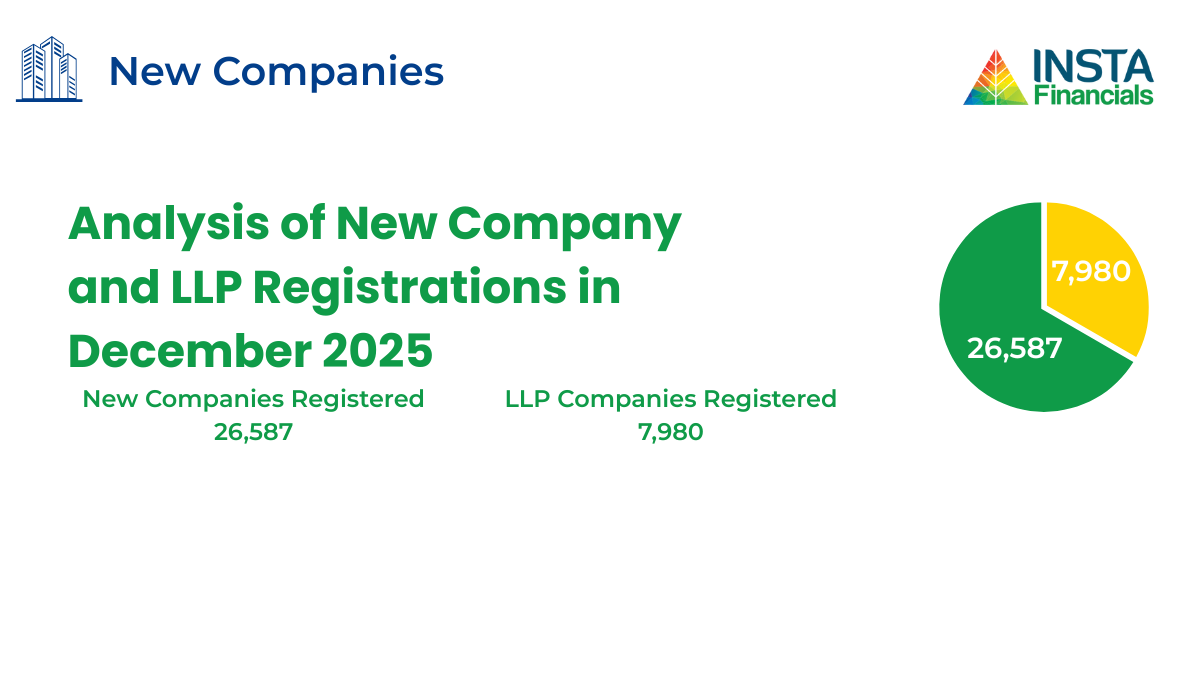
Analysis of New Company and LLP Registrations in December 2025

December 2025 proved to be a strong and encouraging month for entrepreneurship in India.
During the month, 26,587 new companies and 7,980 LLPs were registered — reflecting business confidence, digital adoption, and a renewed appetite for formalizing businesses across industries.
Beyond the impressive headline numbers, the distribution of registrations across sectors reveals where entrepreneurs see future opportunities and how India’s economy continues to diversify.
This article takes a deeper, sector-wise look at these registrations and highlights the business trends shaping India’s growth journey.
Services & Knowledge Industries Continue to Lead

Knowledge-driven and service-oriented businesses continue to dominate new registrations. These sectors benefit from low setup costs, scalability, digital tools, and strong domestic as well as global demand.
Top categories among companies:
- Computer programming, consultancy & IT services – 3,347
- Wholesale trade (non-automotive) – 2,714
- Retail trade (non-automotive) – 1,785
- Real estate activities – 1,243
- Education – 1,103
Why these matters
These industries benefit from:
- Growing SaaS, automation and AI adoption
- Expansion of outsourcing, consulting and digital services
- Higher need for compliance, advisory and accounting support
- E-commerce penetration and new-age retail formats
- Rising demand for skilling, training and online learning platforms
Together, these trends reflect India’s ongoing shift toward a digital-first, service-driven economy, where intellectual capital and professional expertise play a central role.
Social Impact, Healthcare & Community Services on the Rise

A notable development is the steady rise in sectors that directly impact social welfare and human development.
- Social work activities – 1,000
- Human health activities – 616
- Public and social administration – steady but growing
These registrations signal:
- Increased focus on preventive healthcare and wellness
- Expanding NGO and non-profit ecosystems
- Growth in elderly care, rehabilitation, and community support services
India’s demographic shift, lifestyle changes, and heightened awareness of health and social issues are clearly influencing business formation patterns.
Infrastructure, Construction & Real Estate Stay Strong

Real estate and infrastructure remain pillars of long-term economic development.
Key categories:
- Real estate activities – 1,243
- Specialized construction – 885
- Construction of buildings – 536
- Civil engineering – 364
- Warehousing and logistics support – 491
These registrations highlight:
- modernization of logistics networks
demand for residential and commercial projects
highway, urban, and industrial corridor development
investments linked to smart cities and public infrastructure
As urbanization accelerates and manufacturing expands, supportive infrastructure continues to attract entrepreneurs and investors.
Manufacturing: Stable and Expanding

Despite challenges such as capital requirements and regulatory compliance, manufacturing continues to maintain a strong base.
Major segments:
- Food products – 706
- Chemicals – 392
- Pharmaceuticals – 342
- Electrical equipment – 191
- Fabricated metal products – 184
- Textiles – 107
Key drivers behind manufacturing growth:
- Incentives under “Make in India”
- Shift from imports to domestic production
- Opportunities in exports and global sourcing
- Rapid expansion in speciality chemicals and pharma
- Local demand for processed food, FMCG and apparel
Manufacturing not only creates businesses but also supports employment, supply chains, logistics and innovation.
LLPs: Flexible, Professional and Partnership-Driven

Limited Liability Partnerships (LLPs) remain a preferred structure for professional firms and collaborative business models.
In December 2025 alone, 7,980 LLPs were registered.
LLPs are popular among:
- Consultants
- Traders
- Real estate developers
- Legal and financial advisory firms
- Boutique service providers
- Family-run businesses
Top LLP sectors:
- Real estate – 906
- Wholesale trade – 868
- IT & consultancy – 626
- Retail trade – 536
- Management consulting – 424
Entrepreneurs often choose LLPs because they are:
➡ comparatively lighter on compliance
➡ easier to manage in partnerships
➡ suitable for service and project-based business models
They combine professional flexibility with legal protection, making them ideal for emerging entrepreneurs.
Innovation, Creativity & Research Grow Quietly

Beyond traditional sectors, innovation-driven and creative segments also show encouraging traction:
- Scientific research and development
- Creative and entertainment industries
- Publishing and digital media businesses
These businesses may be smaller in number but add long-term intellectual and cultural value, supporting content creation, innovation and digital branding ecosystems.
Sustainability & Environment Gain Attention

Environmental, waste management and utility services recorded steady new registrations.
These include:
- Waste collection and recovery
- Water treatment and supply
- Environmental remediation services
Increasing regulations, climate concerns and corporate sustainability commitments are pushing entrepreneurs toward green and circular economy opportunities.
What This Means for India’s Business Landscape

From the data, three major themes clearly emerge.
Rapid Digital Transformation
Technology, professional consulting, IT services, and digital-led businesses dominate new registrations — showing how digital infrastructure now underpins almost every sector.
Infrastructure-Led Growth
Real estate, logistics, warehousing, and construction continue to attract investments — building the physical backbone for business expansion.
Consumer and Community Driven Diversification
Retail, food, wellness, healthcare, education and entertainment sectors highlight the growing influence of urban consumers and evolving lifestyle needs.

With over 34,500 new business entities registered in December 2025 alone, India continues to demonstrate resilience, entrepreneurial ambition, and structural economic growth.
As digital systems simplify registration, credit access improves and market opportunities widen, we can expect:
- more formalized MSMEs
- stronger knowledge-based industries
- new waves of innovation-driven enterprises
December 2025 offers more than just numbers — it captures the confidence of thousands of new entrepreneurs shaping India’s economic future.


